Your Concrete retaining wall control joint spacing images are available in this site. Concrete retaining wall control joint spacing are a topic that is being searched for and liked by netizens now. You can Find and Download the Concrete retaining wall control joint spacing files here. Find and Download all free vectors.
If you’re searching for concrete retaining wall control joint spacing images information linked to the concrete retaining wall control joint spacing keyword, you have come to the ideal site. Our site always gives you hints for refferencing the highest quality video and image content, please kindly surf and locate more informative video content and graphics that fit your interests.
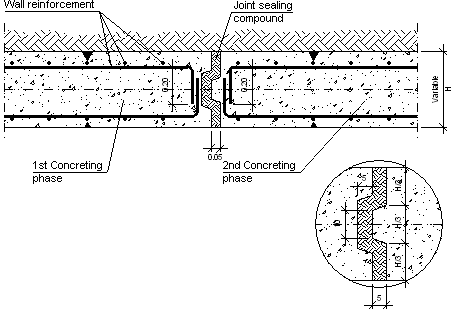
Concrete Retaining Wall Control Joint Spacing. The control joint spacing may not exceed 6 m in NZS 4229 and its positions in the building are shown in Section 63. Maximum horizontal spacing of control joints in unreinforced concrete masonry walls should be approximately 32 feet but a length spacing to height of wall ratio is a better measure. In addition contraction joints should be placed to produce panels that are as square as possible and never exceeding a length to width ratio of 15 to 1 Figure 1. Expansion joints constructed per FIGURE 16 shall be placed at every forth control joint.
 Reinforced Concrete Retaining Wall Specifications For Expansion Joints Structural Engineering General Discussion Eng Tips From eng-tips.com
Expansion joints constructed per FIGURE 16 shall be placed at every forth control joint. Place Vertical expansion joints 12 inch in width at Max intervals of 90 feet throughout the length of. Maximum horizontal spacing of control joints in unreinforced concrete masonry walls should be approximately 32 feet but a length spacing to height of wall ratio is a better measure. Vertical construction joints may not be present. Commercial work would normally accept up to 8 m spacing. This wall was built with expan sion joints spaced every 70 ft 214 m.
Stacked panels are not permitted and less than or equal to 10-0 when panel height is greater than 9-0 provide a maximum post spacing of 8-0 2-0 minimum to 10-0 maximum.
Maximum recommended control joint spacing of Spacing of Control Joints for Type I Concrete Masonry Units with Horizontal Reinforcing. Provide stacked panels when the wall height exceeds 9-0 2-0 minimum to 9-0 maximum barriers mounted on retaining walls and moment slabs. Concrete masonry walls whether they be walls forming part of a building structure retaining or garden walls often require control joints to be built in to counter the effects of drying shrinkage and other movement effects not related to their primary structural purpose. Navy Yard in Pudget Sound Washington. Maximum horizontal spacing of control joints in unreinforced concrete masonry walls should be approximately 32 feet but a length spacing to height of wall ratio is a better measure. An engineered method is presented in TEK 10-3 Control Joints for Concrete Masonry WallsAlternative Engineered Method which is based on limiting crack width to 002 in.
 Source: mdpi.com
Some designers recommend re-ducing joint spacings by about 20 in walls with frequent openings. It is best to cut joints as early as possible either while finishing with a concrete groover or within 6-18 hours after finishing with a concrete saw. Vertical construction joints may not be present. Expansion joints constructed per FIGURE 16 shall be placed at every forth control joint. Joints are commonly spaced at distances equal to 24 to 30 times the slab thickness.
 Source: researchgate.net
The control joint spacing may not exceed 6 m in NZS 4229 and its positions in the building are shown in Section 63. Stacked panels are not permitted and less than or equal to 10-0 when panel height is greater than 9-0 provide a maximum post spacing of 8-0 2-0 minimum to 10-0 maximum. The control joint spacing may not exceed 6 m in NZS 4229 and its positions in the building are shown in Section 63. Control Joints with Horizontal Reinforcement. On changing from a saturated to a dry condition average concrete will contract approximately 23 of an inch per 100 linear feet.
 Source: eng-tips.com
Some designers recommend re-ducing joint spacings by about 20 in walls with frequent openings. An engineered method is presented in TEK 10-3 Control Joints for Concrete Masonry WallsAlternative Engineered Method which is based on limiting crack width to 002 in. The most common and usually most cost effective method of controlling cracks in concrete masonry is to use control joints in conjunction with a minimum amount of horizontal reinforcement between the joints. Control Joints with Horizontal Reinforcement. For floors with only nominal percentage of reinforcement smaller than the minimum specified the concrete floor should.
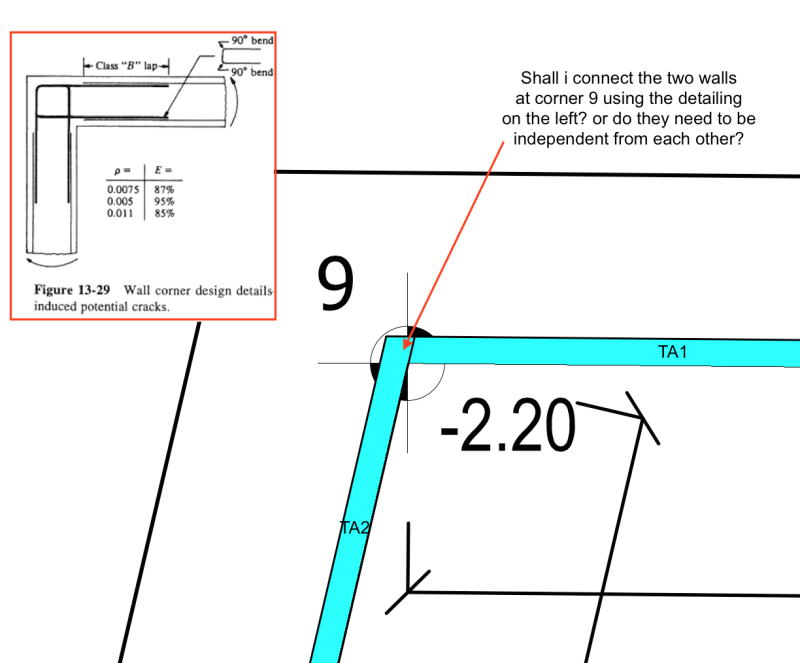 Source: eng-tips.com
Commonly used method of locating control joints and is applicable to most building types. An engineered method is presented in TEK 10-3 Control Joints for Concrete Masonry WallsAlternative Engineered Method which is based on limiting crack width to 002 in. Stacked panels are not permitted and less than or equal to 10-0 when panel height is greater than 9-0 provide a maximum post spacing of 8-0 2-0 minimum to 10-0 maximum. It is best to cut joints as early as possible either while finishing with a concrete groover or within 6-18 hours after finishing with a concrete saw. 4 recommends a contraction joint spacing of 30 times the wall thickness or 20 feet for an 8-inch-thick wall 30 8 240 inches 20 feet.
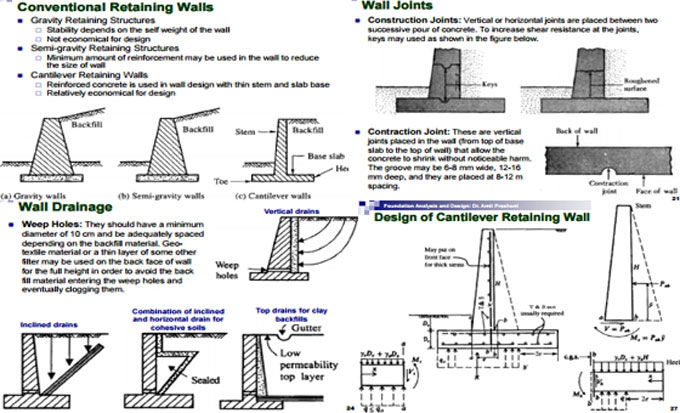 Source: constrblog.wordpress.com
Fairfax County Typical Retaining Wall Details VERTICAL JOINT REQUIREMENTS. Plan out your control joint. Contraction joints ACI and Reclamation control joints Reclamation or saw cut joints Reclamation can be used to control the location of cracking due to drying shrinkage. The system is cast off-site. On changing from a saturated to a dry condition average concrete will contract approximately 23 of an inch per 100 linear feet.
 Source: structuraldetails.civilworx.com
Some designers recommend re-ducing joint spacings by about 20 in walls with frequent openings. On changing from a saturated to a dry condition average concrete will contract approximately 23 of an inch per 100 linear feet. Contraction joints ACI and Reclamation control joints Reclamation or saw cut joints Reclamation can be used to control the location of cracking due to drying shrinkage. The control joint spacing may not exceed 6 m in NZS 4229 and its positions in the building are shown in Section 63. Commonly used method of locating control joints and is applicable to most building types.
 Source:
051 mm since water repellent coatings. For retaining walls common seal construction is horizontal that is continuous between the foot and the wall. Provide stacked panels when the wall height exceeds 9-0 2-0 minimum to 9-0 maximum barriers mounted on retaining walls and moment slabs. Vertical construction joints may not be present. Chapters in the report focus on various types of structures and structural elements with unique characteristics.
Source: eng-tips.com
Buildings bridges slabs-on-grade tunnel linings canal linings precast concrete pipe liquid-retaining struc-tures walls and mass concrete. In addition contraction joints should be placed to produce panels that are as square as possible and never exceeding a length to width ratio of 15 to 1 Figure 1. Expansion joints constructed per FIGURE 16 shall be placed at every forth control joint. Joints are commonly spaced at distances equal to 24 to 30 times the slab thickness. Vertical construction joints may not be present.
 Source: structuraldetails.civilworx.com
Maximum horizontal spacing of control joints in unreinforced concrete masonry walls should be approximately 32 feet but a length spacing to height of wall ratio is a better measure. Fairfax County Typical Retaining Wall Details VERTICAL JOINT REQUIREMENTS. An engineered method is presented in TEK 10-3 Control Joints for Concrete Masonry WallsAlternative Engineered Method which is based on limiting crack width to 002 in. 051 mm since water repellent coatings can effectively resist water penetration for cracks of this size. For retaining walls common seal construction is horizontal that is continuous between the foot and the wall.
 Source: gluedideas.com
Place Vertical expansion joints 12 inch in width at Max intervals of 90 feet throughout the length of. Contraction joint spacing in re s i d e n - tial basement walls and the National Ready Mixed Concrete Association Ref. Vertical construction joints may not be present. Some designers recommend re-ducing joint spacings by about 20 in walls with frequent openings. Control joints or planned breaks are more typical and are spaced at regular intervals.
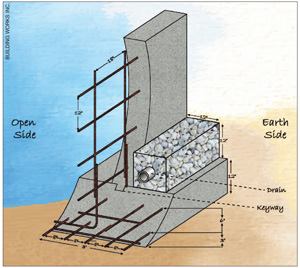 Source: concreteconstruction.net
For retaining walls common seal construction is horizontal that is continuous between the foot and the wall. Control Joints with Horizontal Reinforcement. Maximum horizontal spacing of control joints in unreinforced concrete masonry walls should be approximately 32 feet but a length spacing to height of wall ratio is a better measure. Commonly used method of locating control joints and is applicable to most building types. For retaining walls common seal construction is horizontal that is continuous between the foot and the wall.
 Source: eng-tips.com
The use of control joint blocks shown in Figure 8 has. Maximum recommended control joint spacing of. Control joints or planned breaks are more typical and are spaced at regular intervals. Control joints constructed per FIGURE 15 shall be placed no more than 20 feet on center. An engineered method is presented in TEK 10-3 Control Joints for Concrete Masonry WallsAlternative Engineered Method which is based on limiting crack width to 002 in.
 Source: in.pinterest.com
For floors with only nominal percentage of reinforcement smaller than the minimum specified the concrete floor should. Commonly used method of locating control joints and is applicable to most building types. In addition contraction joints should be placed to produce panels that are as square as possible and never exceeding a length to width ratio of 15 to 1 Figure 1. The wall compo-nent which encompasses the face panel and the counter-forts and the base slab Fig. Some designers recommend re-ducing joint spacings by about 20 in walls with frequent openings.
 Source: researchgate.net
Control Joints are not intended to stop cracking but rather control cracking. Control joints or planned breaks are more typical and are spaced at regular intervals. The wall compo-nent which encompasses the face panel and the counter-forts and the base slab Fig. Concrete masonry walls whether they be walls forming part of a building structure retaining or garden walls often require control joints to be built in to counter the effects of drying shrinkage and other movement effects not related to their primary structural purpose. Discussion of the causes and control of cracking in concrete construction.
 Source: pinterest.com
Lewerenz 1907 cites a plain concrete retaining wall located at the US. Control joints constructed per FIGURE 15 shall be placed no more than 20 feet on center. Control joints or planned breaks are more typical and are spaced at regular intervals. Place Vertical expansion joints 12 inch in width at Max intervals of 90 feet throughout the length of. Commonly used method of locating control joints and is applicable to most building types.
This site is an open community for users to submit their favorite wallpapers on the internet, all images or pictures in this website are for personal wallpaper use only, it is stricly prohibited to use this wallpaper for commercial purposes, if you are the author and find this image is shared without your permission, please kindly raise a DMCA report to Us.
If you find this site serviceableness, please support us by sharing this posts to your preference social media accounts like Facebook, Instagram and so on or you can also save this blog page with the title concrete retaining wall control joint spacing by using Ctrl + D for devices a laptop with a Windows operating system or Command + D for laptops with an Apple operating system. If you use a smartphone, you can also use the drawer menu of the browser you are using. Whether it’s a Windows, Mac, iOS or Android operating system, you will still be able to bookmark this website.